





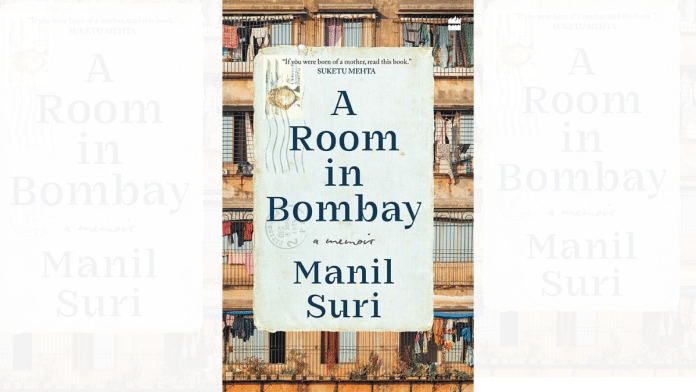


New Delhi: ‘A Room in Bombay’ is a layered memoir which inculcates a wide range of themes ranging from filial relationships to sexuality and the nuances of migration, among other subjects. The core of the memoir centres around the relationship between the author and his mother, Prem, who feels bound to the aforementioned room, having suffered the trauma of partition and displacement. As in any South Asian household, the relationship is complex, consisting of parental love and attachment, especially from the perspective of an individual who has witnessed the horrors of partition and an estranged alcoholic husband with whom she finally shares the cramped apartment after a long period of separation. The numerous letters used in the memoir lend a personal and emotional touch.
The memoir also serves as a testament to the strength of the secular ethos of India, which survives even after being ravaged by partition. The author’s family, Hindu, has to share the crumbling apartment with three Muslim families in an interplay of religious co-existence, co-dependence and cosmopolitanism. The memoir also traces the transformation of Bombay to Mumbai, while showcasing a cramped middle-class life in a city usually known for its glamour. In that sense, it holds up an image of the city that usually misses the eye in day to day conversations. The families jostle for space amidst shared toilets, noisy corridors and growing urbanization.
The room itself is not confined to being just a location, but is infused with life through the lives of its characters. It assumes the shape of post-colonial India itself – overcrowded, emotionally compressed and historically layered. It is also a challenge for the author, a queer individual, to navigate the boundaries of freedom in a cramped middle-class environment where privacy is a rare luxury. Liberalism is forced to co–exist within the contours of a conservative society and all its hurdles.
Migration also plays a central theme in the author’s work. He migrates to America when he is 20, searching for liberty and professional freedom. Yet, he finds himself emotionally tied to his mother, as might be commonplace in South Asian households, and vice-versa. Living abroad has its own burdens- loneliness and a longing for home. Even though the author moves to a more liberating atmosphere, he feels tied to his mother back in Mumbai and suffers the pangs of separation and survivor guilt. The memoir ties all these complicated themes together to furnish a piece of art which moves the reader in more ways than one.
Published by HarperCollins, ‘A Room in Bombay’ by Manil Suri will be released on 23 May on SoftCover, ThePrint’s online platform for launching non-fiction books.
Manil Suri is an Indian-American novelist whose book, “The Death of Vishnu” was long-listed for the 2001 Booker Prize, short-listed for the PEN/Faulkner award in 2002, and won the Barnes and Noble Discover Prize the same year. “A Room in Bombay” is his first memoir.