





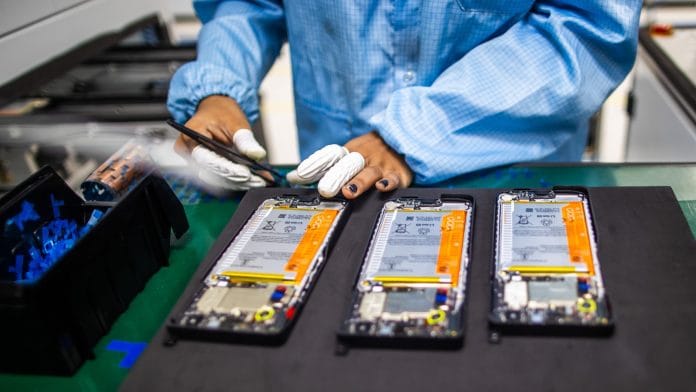



New Delhi : India is drafting a new round of smartphone manufacturing incentives that would link government subsidies to exports and deeper use of locally made components, in a move that will benefit Apple Inc., Samsung Electronics Co. and their suppliers, according to people familiar with the matter.
The proposal — effectively a second phase of New Delhi’s flagship phone production program — will start rewarding companies for shipping devices overseas, the people said, asking not to be identified because the discussions are private. Unlike the current Production-Linked Incentive, or PLI, program which retires March 31 and is primarily focused on incremental domestic output, the new plan explicitly ties benefits to exports and localization.
The policy design, size of the incentives and the overall budget are still being finalized and may change during the inter-ministerial consultations, the people said.
The incentive overhaul underscores Apple’s growing importance to India’s electronics ambitions. The iPhone maker’s contract manufacturers account for roughly three-fourths of the country’s smartphone exports, helping transform India into one of the world’s fastest-growing handset export hubs. Apple aims to ship most US-bound iPhones from India by year-end, reinforcing India’s position as the top maker of smartphones sold in the US.
India’s Ministry of Electronics and Information Technology did not immediately respond to an email seeking comment.
With nearly every smartphone sold in India now assembled locally, officials believe the initial incentive program has largely met its goal of satisfying local demand, the people said. Policymakers are now shifting focus to higher value addition as the next stage of the strategy beyond screwdriver assembly.
The government is also seeking to nudge Chinese smartphone brands like Oppo, Vivo and Xiaomi — all of which primarily manufacture in India for the domestic market — to use the country as an export base, according to a person familiar with the government’s thinking.
Tying benefits to overseas shipments in its flagship PLI policy is seen as a way to embed India more deeply into global supply chains at a time when manufacturers are recalibrating production footprints to hedge from geopolitical risks.
Make in India
A second key feature under discussion is heavy indexation to localization. Incentives are likely to be tiered based on the extent of local value addition in each device rather than simple assembly. Manufacturers could receive additional benefits for sourcing components such as camera modules, display assemblies and other sub-parts from Indian suppliers.
Devices that meet higher localization thresholds and are exported could receive the maximum subsidy, the people said.
India’s hurdles, however, have extended beyond costs, underscoring that building a deep supply chain takes time. Apple’s expansion has been constrained by a thin supplier base which can meet its quality standards, higher logistics costs and the challenge of matching China’s scale and efficiency.
While India has successfully attracted large-scale assembly for brands including Apple and Samsung, high-value components — such as semiconductors and advanced modules — continue to be imported from countries including China, South Korea and Taiwan.
Rival China
For Prime Minister Narendra Modi, the revamp will mark a natural progression of his government’s Make in India program to rival China as a global manufacturing hub — shifting from import substitution and domestic assembly toward embedding itself deeper in global supply chains.
The new incentives are expected to dovetail with New Delhi’s Electronics Components Manufacturing Scheme, which aims to promote domestic production of parts and sub-assemblies.
On Monday, Dixon Technologies (India) Ltd., the country’s largest homegrown contract manufacturer of electronics, said it has received government approval to form a joint venture with China’s HKC Corp. to manufacture display modules in India.
Since the current PLI program for smartphone assembly ends this month, companies have been seeking clarity for months on the new version of the incentive program to draw up plans for India exports, one of the people said.
This report is auto-generated from Bloomberg news service. ThePrint holds no responsibility for its content.
Also Read : Caught in debt spiral, Maharashtra farmer sold his kidney. It blew lid off transnational racket