







New Delhi: When Union Minister for Minority Affairs Kiren Rijiju launched the UMEED portal on June 6 last year, he gave India’s 38 Waqf Boards six months to put every Waqf property onto the single digital platform.
Six months later, only 27 percent had made it through. The government quietly extended the deadline. Six months after that, a progress report analysed by ThePrint shows 5,43,597 of India’s 8.72 lakh Waqf properties have received final approval, roughly 62 percent.
A portion of the rest remains at different stages of the workflow process, while no record has been submitted for more than 1 lakh Waqf properties.
The Unified Waqf Management, Empowerment, Efficiency and Development) portal was created after the parliament passed the contentisous Waqf (Amendment) Act, 2025 amid intense political debate and protest by community groups.
The BJP-led NDA government had said the amendment would bring about transparency and accountability in the management of Waqf properties, while the critics claimed the act would enable government interference and overtake of Waqf property.
After the launch of the portal, states like Punjab, Telangana, and Jammu and Kashmir performed well through the year.
West Bengal, which had registered just 716 properties at the December deadline under a resistant Trinamool Congress government, shot up to 86,222 approvals as the BJP swept the May 2026 state election and the new Suvendu Adhikari government moved to comply. While the definitive numbers are unclear, the bulk applications came since Adhikari took over.
Delhi and Maharashtra, meanwhile, remain heavily stalled at the verification stage.
Speaking at the Minority Affairs Ministry’s Reform Utsav event last week, Riji said what happens to the properties that never made it is not looking good for Waqf Boards. “The fate of the unregistered properties remains to be seen,” he said, “and will likely end up with the government”.
The UMEED Portal Progress Report, generated on June 8, captures the full national picture across all 38 State Waqf Boards.
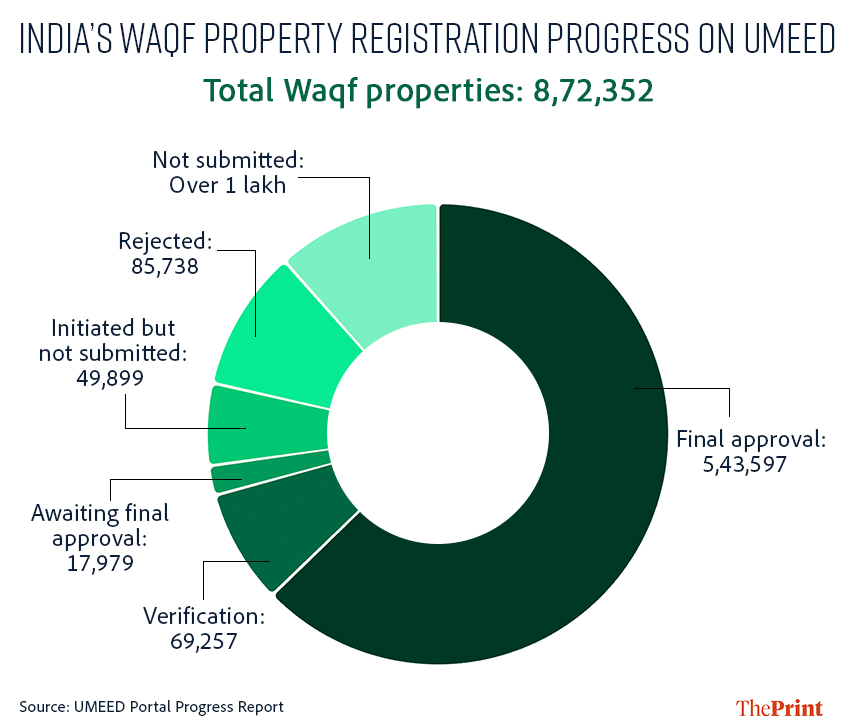
Beyond the 5,43,597 approvals, another 69,257 entries are pending at the verification stage, 17,979 have cleared verification and are awaiting final sign-off, and 49,899 have been initiated but not yet submitted up the chain.
On the rejection side, 85,738 entries have been knocked back and returned for correction. Across all stages, 7,66,470 properties have been touched by the portal since the launch, leaving roughly one lakh properties from the previous government count that have not appeared on UMEED in any form.
Rijiju acknowledged the “slow” pace at the Reform Utsav sidelines. “The progress has been a bit slow due to issues with the portal and technical glitches and problems related to mutawallis being unable to understand the system,” he said, adding that the ministry was extending “all support” and would “soon come up with additional ways to help them out”.
Also Read: What is ‘waqf-by-user’ and why it’s at centre of debate over contentious amendments to waqf law
The backdrop
Before UMEED, Waqf records lived on WAMSI, the Waqf Assets Management System of India, in operation since 2009. Prior to WAMSI, records had been maintained for over a century in district ledgers, in Urdu and Arabic.
By WAMSI’s count, approximately 8.72 lakh immovable Waqf properties existed across more than 38 lakh acres in India, estimated at Rs 1.2 lakh crore.
The government has described India as the largest holder of Waqf property in the world. Within India, waqf holdings come third only after the armed forces and Indian Railways.
A separate analysis of WAMSI showed that only 9,279 ownership documents had been uploaded for 8.72 lakh properties, and only 1,083 Waqf deeds were available digitally. The status of 50 percent of properties was simply unknown.
UMEED introduced a three-tier workflow to fix that. A mutawalli, the custodian of a Waqf property, first submits the property’s details onto the portal. In this role, the mutawalli is designated the Maker.
That entry then moves to a Waqf Board official, designated the Checker, who verifies the submitted records against existing documents and land records. Once the Checker clears it, the entry goes to a senior Board official, typically the CEO, designated the Approver, who gives the final sign-off.
A property is counted as fully registered on UMEED only after it clears all three stages. Entries rejected at the Checker or Approver stage travel back to the Maker for correction and the chain then restarts.
The Waqf (Amendment) Act, 2025, which mandated this system, was contentious from the start. The Lok Sabha passed it 288-232 after a 12-hour debate; the Rajya Sabha took 14 hours and passed it 128-95.
More than 65 Supreme Court petitions challenging the Act led to a partial stay on two provisions in September 2025. The All India Muslim Personal Law Board called the portal illegal and moved the Supreme Court to suspend it. The court declined.
Only 69 registrations in 2 months
The first two months of the portal’s life set the tone. Two months after the launch, only 69 properties had been uploaded on UMEED, and only 663 mutawallis had even started the data entry process. The portal crashed repeatedly.
In Bihar, the mutawalli of a Waqf created when Aurangzeb had been dead for a decade was still writing to the helpdesk, unable to upload a Waqf village. Boards in several states reported the portal could not accommodate survey and gazette-notified properties. A mutawalli from Madhya Pradesh went to the Supreme Court calling the platform “technologically incapable of fulfilling its statutory purpose”.
On 5 December, the deadline, Rijiju told reporters, “Today is the last day, and lakhs of Waqf properties have still not been registered. Many MPs and social leaders came to me requesting that problems are being faced in registering more than 9 lakh Waqf properties.”
He declined to extend the deadline. The portal closed at midnight on December 6. At that point, 5,17,040 properties had been initiated and 2,16,905 had received final approval, around 27 percent of the total. Rijiju announced that no penalties would be imposed for three months on those who had not registered, and urged mutawallis to approach their state Waqf Tribunal for extensions.
State-by-state picture
The report covers all 38 boards and the variation is wide. Punjab has 25,373 approved properties with negligible numbers still in the pipeline. Jammu and Kashmir has 25,248 approved. Telangana has pushed 54,550 to the final approval, the second highest of any board nationally. Andhra Pradesh has 14,698.
Delhi sits at the opposite end: 64 approved, 2,846 entries pending with Checkers, and 269 still at the initiated stage, with the pipeline almost entirely stalled at the verification stage six months after the deadline.
Maharashtra has 17,178 approved but 27,926 entries pending with checkers and 9,790 with approvers, meaning large volumes have been uploaded but are moving slowly through the chain. Kerala has 49,443 approved, but 12,141 entries remain with checkers and 4,013 with approvers.
Arunachal Pradesh, Goa, Ladakh, Mizoram, Nagaland, and Sikkim show zero across every column.
West Bengal: from 716 to 86,222
The most striking shift between December 2025 and the latest report is West Bengal. At the December deadline, the state had registered 716 properties out of 80,480, a completion rate of 0.89 percent. The then Trinamool Congress government had resisted implementing the Waqf Amendment Act for months before directing officials to upload details only in the portal’s final week.
The 8 June report shows 86,222 properties approved in West Bengal, 7,827 pending with checkers, and 3,760 still at the initiated stage. The total pipeline of 1,10,491 is now among the largest in the country.
The BJP wrested control of West Bengal from the Trinamool Congress in the May 2026 assembly election, with Suvendu Adhikari sworn in as Chief Minister on 9 May. The new government moved to implement the UMEED framework, and the approvals followed in the weeks since. West Bengal went from the worst-performing major state in December to one of the highest in absolute approvals by June.
Uttar Pradesh: the most complex case
Uttar Pradesh holds more Waqf property than any other state, and its portal numbers are the most layered. The UP Waqf Tribunal granted both Sunni and Shia boards a six-month extension to 5 June 2026, citing persistent technical glitches.
The report shows UP Sunni with 1,03,540 approvals, the highest of any single board nationally. But it also shows 13,880 properties still at the initiated stage, 5,551 pending with checkers, and 29,747 rejected and returned to makers, the highest rejection count of any board in the country. UP Shia has 4,751 approved and 2,059 rejected.
The verification drive through the extended window produced its own findings. Authorities cancelled registrations of 31,328 properties after a large-scale review found widespread discrepancies. Officials said 31,192 claims were rejected following scrutiny that revealed mismatches between uploaded details and revenue records, including incorrect Khasra numbers and inconsistencies in land area.
In a statement in the last week of May, UP Minority Welfare Minister Om Prakash Rajbhar said properties not registered on the portal could be subject to seizure. Properties whose registrations were cancelled had been issued notices and given time to correct deficiencies before 5 June. “Thereafter, only properties with valid records will remain with the Waqf,” he said. That deadline passed three days ago.
The 1.06 lakh question
Even with 5,43,597 approvals, a gap persists between what WAMSI had on record and what has shown up on UMEED. On 9 December 2024, Rijiju had told Rajya Sabha that India had 8,72,352 immovable Waqf properties based on the WAMSI data.
The 8 June report shows 7,66,470 properties across all workflow stages. As of March 2026, nearly 1.05 lakh Waqf properties had not been submitted to UMEED at all. The government has not addressed that gap directly.
The Supreme Court has not yet ruled on the constitutional validity of the Waqf (Amendment) Act, 2025. More than 85,000 entries have been rejected and returned to mutawallis for correction
Rijiju’s remark last week that unregistered properties will “likely end up with the government” is the closest the government has come to stating the consequence plainly. What that process looks like, and on what legal basis it proceeds while the Act itself remains under challenge in the Supreme Court, he has left for another day.
(Edited by Ajeet Tiwari)
Also Read: Removal of ‘waqf by user’ isn’t just about land—it erases memory, practice, and pluralism