







Sign up for the daily India Edition newsletter by Menaka Doshi – an insider’s guide to the emerging economic powerhouse, and the billionaires and businesses behind its rise.
Major global hotel chains including Marriott, IHG and Hilton are aggressively expanding in India, betting that a domestic tourism boom can withstand a broader consumer spending slowdown and stock market slump.
There has been a flurry of recent hotel deals. IHG Hotels & Resorts in May said it would work with the airports arm of billionaire Gautam Adani’s namesake conglomerate to develop five hotels in key aviation hubs and debut its ultra-luxury Kimpton brand in India. Accor SA plans to bring its premium eco-luxury Mantis brand to a tiger reserve in Karnataka, while Hilton Worldwide Holdings Inc. and Wyndham Hotels and Resorts Inc. signed agreements in April for properties in some fast-growing smaller Indian cities.
The rush by hotel operators to add rooms reflects a surge in demand from India’s growing middle class, which is traveling more frequently and venturing beyond major cities. That’s in spite of signs of increasing pressure on consumption growth due to higher inflation and recent fuel price hikes. An urban consumer confidence survey released June 5 by the Reserve Bank of India showed that households’ sentiment on spending “significantly weakened” in May as did spending sentiment expectations for the coming 12 months.
A report last week from market research company Kantar said that while Indians are becoming more selective in spending, “travel and meaningful experiences” remain important to many. It said 60% of the roughly 1,700 individuals it surveyed in May indicated they intend to take a domestic holiday in the next 12 months, while 52% were looking to travel internationally.
Major local travel platform EaseMyTrip is recording double-digit growth in domestic leisure bookings, and one of the biggest drivers has been religious and spiritual journeys.
Demand for premium destinations, from the beaches of Goa and the mountains of Kashmir to wildlife reserves and pilgrimage centers, has climbed as much as 20% for the summer season, according to the Indian Association of Tour Operators. Hotel room rates have risen as much as 25% in popular destinations across the country, while airfares and prices for local transportation and restaurants have also gone up, according to Ravi Gosain, the group’s president.
Austerity Plea
Prime Minister Narendra Modi last month urged Indians to limit non-essential overseas travel for at least a year, and choose vacations within the country’s borders. He framed it as economic patriotism, in part to reduce pressure on the rupee when Indians sell it to buy foreign currencies.
Modi’s appeal could “further encourage travelers to rediscover domestic tourism, which is already witnessing sustained growth backed by strong infrastructure development, new airports, better highways, and increasing tourism-focused initiatives across states,” said EaseMyTrip’s founder, Nishant Pitti. The Iran war, meanwhile, has pushed up international airfares and reduced flights through Persian Gulf hubs.
Hotel investments in India surged 67% to $567 million last year, according to JLL, while demand is forecast to rise about 11% annually over the next several years, outpacing supply. India has roughly one hotel room for every 3,000 people, compared with one for every 60 in the US, according to figures from Hilton. The country’s domestic travel and tourism market is expected to reach $216 billion this year, up nearly 8% from 2025, according to data from the World Travel & Tourism Council.
Five-star hotel bookings more than doubled in April from a year earlier, while family hotel bookings surged 125%, according to data from Cleartrip shared with Bloomberg News. A luxury Westin wellness retreat in the Himalayan foothills near the spiritual destination of Rishikesh runs nearly $1,900 per night for a garden suite with a private plunge pool in mid-June. (In Delhi, a 1,100-square-foot suite with a living room and entertainment area at the Westin runs about $500.)
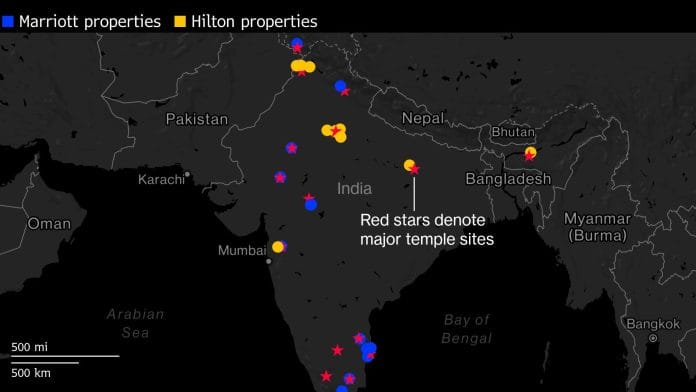
Pilgrims are increasingly extending trips beyond short temple visits, according to Rajeev Menon, Marriott International Inc.’s president for Asia Pacific excluding China. “Now people are staying two to four nights because they’re doing social events there, they’re doing a little birthday party and sightseeing.”
Marriott says about 11% of its roughly 220 hotels in India operating this year cater to temple visitors. Hilton, which has 94 hotels already operating in the country or in the pipeline, has roughly 15% of its portfolio in spiritual hubs. While operating in some holy cities requires international brands to forgo alcohol sales, executives say the demand more than offsets the constraints.
“The religious tourism alone fills the season, and the rates alone are astronomical,” said Clarence Tan, Hilton’s senior vice president of Asia Pacific development, adding that he sees the demand continuing to grow due to rising affluence and people’s “increasing interest in reconnecting with cultural and religious roots.”
Long-Term Growth
Marriott, already the largest international hotel operator in India, plans to add another 180 properties that will create 30,000 more rooms in the country over the next few years. That makes India its fastest-growing market in the Asia-Pacific region after China, and Menon said the chain sees significant opportunities beyond the major gateway cities.
Still, the hotel boom faces risks if India’s economic weakness lingers or deepens, given its heavy reliance on domestic spending. The country’s stock market benchmark, the BSE Sensex, has dropped nearly 14% so far this year, which could make people feel less wealthy and more cautious about big-ticket spending.
Hotel chains say they are planning for the long-term. The industry’s construction pipeline reached a record 906 projects last year, representing about 118,000 additional rooms, according to Lodging Econometrics, trailing only the US and China.
Hilton’s Tan said there’s significant untapped potential from overseas visitors. Inbound visitor arrivals to India totaled about 9.2 million last year, a relatively small figure for the world’s most populous country. “For a country as big as this, it’s almost criminal,” he said.
–With assistance from Chester Dawson.
This report is auto generated from the Bloomberg news service. ThePrint holds no responsibility for its content.