





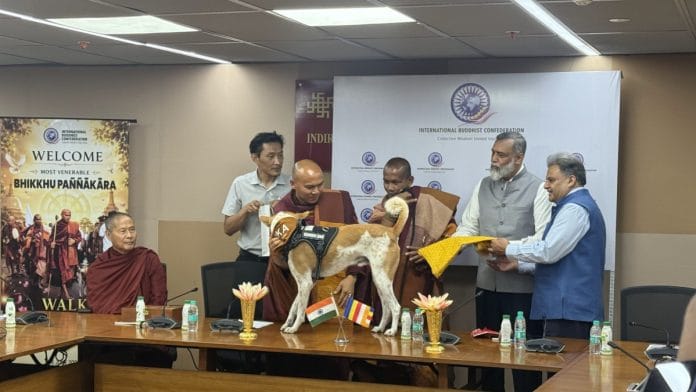


New Delhi: A group of Buddhist monks who walked thousands of miles across the United States with a message of peace and mindfulness arrived in India Monday, accompanied by Aloka, a dog they adopted in 2022 that has since become an international peace mascot.
The delegation, led by Bhikkhu Pannakara, was welcomed at an event at the Indira Gandhi National Centre for the Arts (IGNCA) in New Delhi. The programme brought together monks, officials from the International Buddhist Confederation (IBC) and guests for a discussion on Buddhism, mindfulness and compassion.
The monks’ Walk for Peace has taken them from Fort Worth, Texas, to Washington DC, across more than ten American states. They have also undertaken similar walks in Sri Lanka and Thailand. In India, Pannakara said, they hope to promote peace through mindfulness.
“If we slow down, we will find peace. If we look within, we will find peace,” he said.
Pannakara had earlier completed a 3,400-km pilgrimage through India and Nepal in 2022. It was during that journey that Aloka joined them.
Pannakara said Aloka found the monks while they were walking from Kolkata airport to Bodh Gaya. It was the sixth day of a 112-day journey. Several dogs followed the monks at different points, he said, but most dropped off after a few days.
“Only Aloka stayed with us,” Pannakara said.
After the walk ended in Bodh Gaya, Pannakara decided to take Aloka to the United States. Since then, Aloka has travelled with the monks to Sri Lanka, Thailand and now India.
Humanity’s responsibility to live with compassion
At the IGNCA event, IBC officials placed the monks’ journey within the Buddhist tradition of walking and meditative practice. Professor Ravindra Panth, IBC director, said the monks’ journey showed that peace was not an abstract concept but “a practice to be lived”.
Former IBC director general Abhijit Halder said the walk was not merely a journey from one point to another, but “a journey touching human hearts”. In a world obsessed with speed, he said, the monks chose the opposite.
“You chose a mechanism which is not to do with speed. It is to do with slow, easy movement,” Halder said. “This is a message you have conveyed to the whole world: that you need to stop somewhere.”
Aloka, Halder added, played a critical role in connecting people to the walk, especially children who followed updates about his health and condition.
Later, in a separate interaction at her residence, animal rights activist Maneka Gandhi said Aloka’s presence had drawn attention to the relationship between humans and animals at a time when the place of street dogs in Indian cities remains contested.
“Dogs, humans, cats, trees, they all have life,” Gandhi said. “They bring us a great deal of joy. They look after us, they protect us. And if they are cared for properly, there is no downside to this.”
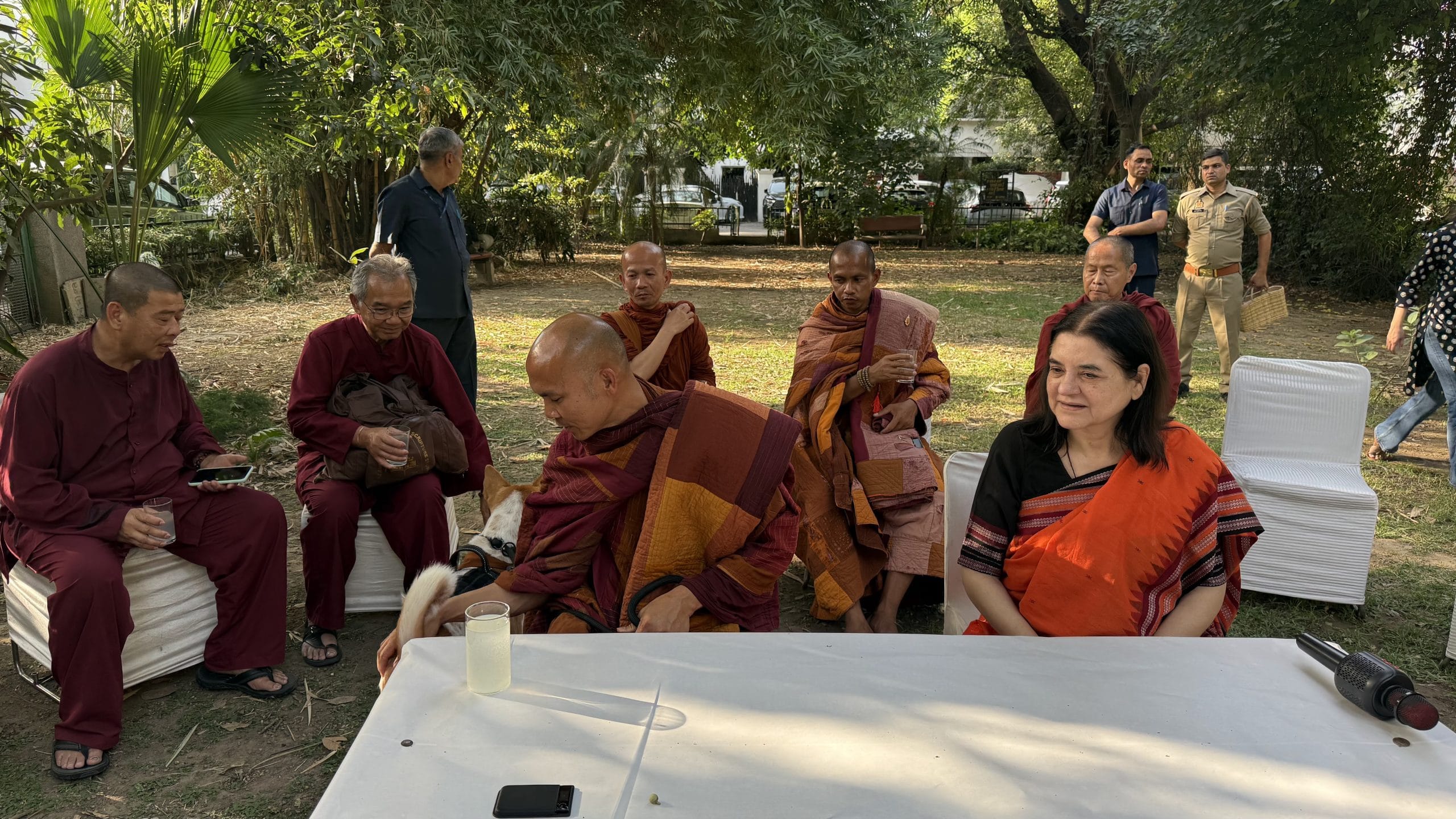
On having Aloka on the journey, Pannakara told ThePrint that it helped people see a different relationship between humans and animals.
“During the walk, people see how human beings and animals can live together differently. And so people understood how we should live with each other,” he said. “There are no boundaries to loving kindness and compassion. Therefore, all beings deserve a better life.”
Pannakara argued that the responsibility to live with compassion could not rest with governments alone.
“We cannot just depend on the government alone; we have to be part of it,” he said. “Governments also have to do their part.”
Pannakara, who was an engineer before becoming a Buddhist monk, reflected on how his life has changed.
“From an engineer to becoming a Buddhist monk, it changed completely,” he said. “I went from a busy life of earning money to becoming a Buddhist monk, doing temple work, practising the Buddha’s teachings and carrying forward this mission of peace. Everything changed.”
For the monks, the Walk for Peace is a spiritual mission carried out on foot across countries and communities. Aloka, who once followed them along a road in India, now travels with them as a reminder that, in their understanding of Buddhism, compassion does not stop with human beings.
(Edited by Prashant Dixit)